











In this article, you will learn why routines are a lifesaver for dementia care.
Understand practical tips for creating comforting, predictable schedules that ease confusion and support caregivers every step of the way.
One Tuesday, I cried in a CVS parking lot.
Not because of the toothpaste aisle (although let’s be real, why are there 87 versions of mint?) — but because Mom refused to put on pants for the fourth time that week, and I hadn’t showered since Sunday, and the cat peed on the comforter again.
Routine? What routine?
You see, before I worked at a memory care home, I took care of my mother, who had dementia for over two years.
It felt like I was doing everything wrong. The books said “structure brings calm” and I was like—cool, but what about the days where brushing teeth is an Olympic sport and dinner is a slice of cheddar and three Tic Tacs?
But that’s the thing.
It’s not about doing it right. It’s about doing it again.
Even when it sucks.
Even when it fails.
Even when the only thing predictable is your daily 3 PM cry in a CVS parking lot.
Because for someone with dementia, the world is already fuzzy and scary and backward. A consistent routine doesn’t just help them function—it gives them a reason to trust you. Trust the day. Trust themselves.
And yeah, it helps you too.
Imagine waking up and not knowing where you are. Not recognizing your own bedroom. Wondering who the stranger is making toast in your kitchen.
That’s Tuesday morning for someone with dementia.
They live in a loop of What the hell is happening? and Who are you again? And that loop only spins faster when life gets messy—which it always does.
But here’s where routine comes in like a secret weapon.
It’s the same blue mug every morning. It’s hearing Sinatra during lunch. It’s brushing teeth before bed, even if it takes six tries. It’s boring. Blessedly boring.
That sameness? It’s not boring to them. It’s safety. It’s a little breadcrumb trail back to a reality that’s slipping through their fingers.
And when you keep showing up in that same rhythm—wake, eat, walk, rest—they start to breathe easier. You might even get a smile. A rare, beautiful, flickering moment of peace.
Chaos makes dementia symptoms worse.
Routines calm the storm.
They don’t cure anything, but they do soften the blows.
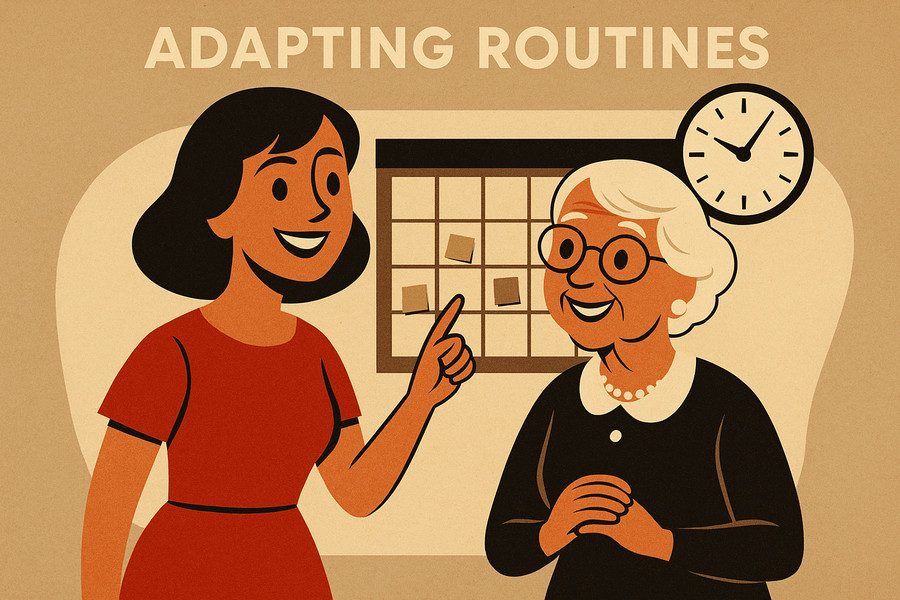
Let’s get one thing straight—this isn’t about making a Pinterest-worthy care calendar.
You’re not a cruise director. Or Mary Poppins. (Though if you can sing Spoonful of Sugar without sobbing, teach me your ways.)
Your daily routine is a lifeline. It’s not a checklist you fail at every time the eggs burn or Mom refuses to nap. It’s a net—and even if you fall through it sometimes, it still catches you.
Because when your person with dementia knows what’s next (or at least feels the rhythm), they freak out less. Which means you freak out less. Which means you can maybe even drink a coffee while it’s still hot. Revolutionary, I know.
Some tips that have saved my butt:
Routines aren’t sexy. They’re not Insta-worthy. But they work.
And on days when nothing works… they’re still there. Waiting to be tried again tomorrow.
Mornings used to be a disaster.
Picture me, half-dressed, chasing Mom through the hallway with a toothbrush while the coffee machine screams like it’s possessed.
Not exactly the soothing “sunrise yoga and green smoothie” vibe people write about.
So I started over.
I gave up on doing it all and focused on doing the same. The same mug. The same playlist. The same phrase (“Good morning, sunshine!”) even if she didn’t answer.
Turns out, it helped.
Even when she couldn’t remember the day or the reason she was awake, she started responding to the pattern.
Here’s what worked for me:
The whole thing takes 30 minutes, and it makes the rest of the day less… angry.
Mornings are still hard. But they’re no longer war.
If I had a dollar for every time lunch turned into a meltdown…
Let’s just say I’d be writing this from a villa in Portugal with room service and no pants.
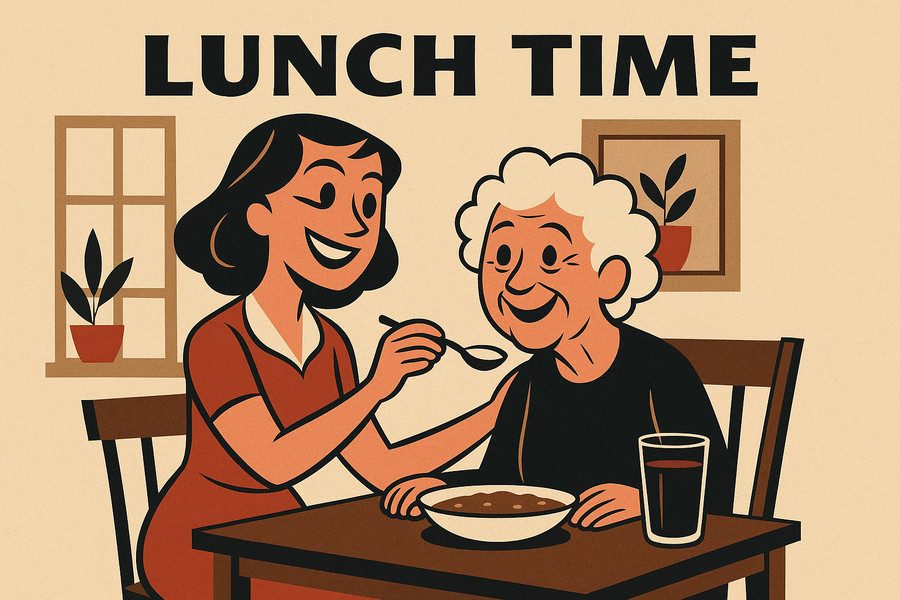
Turns out, eating isn’t just about calories—it’s about comfort. Timing. Smell. Familiar sounds.
Dementia messes with hunger cues, so your loved one might not feel hungry even if their blood sugar is tanking. Or they might feel hungry but be unable to do anything about it.
That’s where routine comes in.
Same time. Same seat. Same plate, even.
Lunch at 12. Dinner at 6. Snacks in between if needed. No surprises.
And it’s not just for them—it’s for you. You’re not scrambling every day trying to guess when or what they want. You’re not turning into a short-order cook or getting screamed at for offering applesauce at the “wrong” hour.
We lit a little battery-operated candle during meals then. It was the tiniest ritual. But she liked it.
She waited for it.
Sometimes, she even said thank you.
Here’s the thing about dementia: it doesn’t clock out at noon.
You don’t get a break just because lunch went okay. In fact, midday is when things can go sideways real fast.
Enter: the witching hour of boredom.
If your loved one with dementia doesn’t have something (anything!) to do in the afternoon, they will find something.
And spoiler alert—it usually involves rearranging sock drawers, accusing the cat of stealing jewelry, or trying to “go home” (when they’re already home).
Midday needs structure. Not a rigid schedule, but a loose framework. Like scaffolding. Not to restrict, but to hold up what’s left.
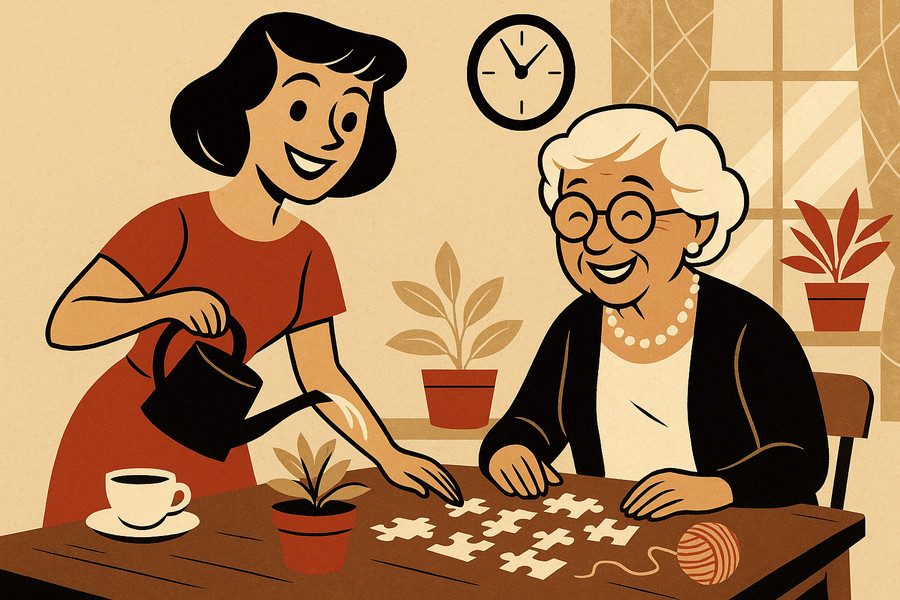
Don’t overthink “activities.” It doesn’t have to be adult coloring books or memory games with 97 pieces.
Try this instead:
The goal isn’t stimulation. It’s soothing through motion. Giving their hands and brain a task. Recreating the rhythm of a regular life.
Afternoons are long. But with simple, predictable activities, they don’t have to feel endless.
Confession: I’m not a gym person.
Never have been. Never will be.
And trying to get my dementia-addled parent to “exercise” felt like trying to explain TikTok to a pigeon.
But movement? That’s different. Movement is natural. Movement is human.
It’s how we feel alive.
So sneak movement into your routine like it’s a secret ingredient in chocolate chip cookies.
A walk to the mailbox. Two songs’ worth of gentle dancing. A hallway “parade” with scarves. Stretching arms while we sing the “Itsy Bitsy Spider” (don’t laugh—it works).
She didn’t need cardio. She needed connection. She needed to feel in her body again, even for a moment.
Here’s what helped:
Movement clears the fog. It settles the nerves. It helps with digestion, mood, sleep, everything.
And yeah—sometimes I danced too. Not because I wanted to, but because joy is contagious.
Even when it’s ridiculous.
Especially then.
There’s a weird thing that happens when you turn on a song from 1963.
Eyes light up. Shoulders drop. Words come back, sometimes entire verses.
Music is memory’s secret password.
And for someone with dementia, sound isn’t just background noise—it’s emotional GPS. It tells them where (and when) they are.
So we built a sound routine.
No, it wasn’t always on time. Yes, I got pushback. But the structure helped.
TV, on the other hand? That’s trickier. Some shows agitate more than they soothe. The news is a hard no.
But familiar sounds—wind chimes, birds outside, the soft tick of a kitchen clock—those things matter. They grounded her. Reminded her that she was home. That she was safe.
And if the day gets loud, and scary, and weird?
We put on Bridge Over Troubled Water.
She always hummed along.
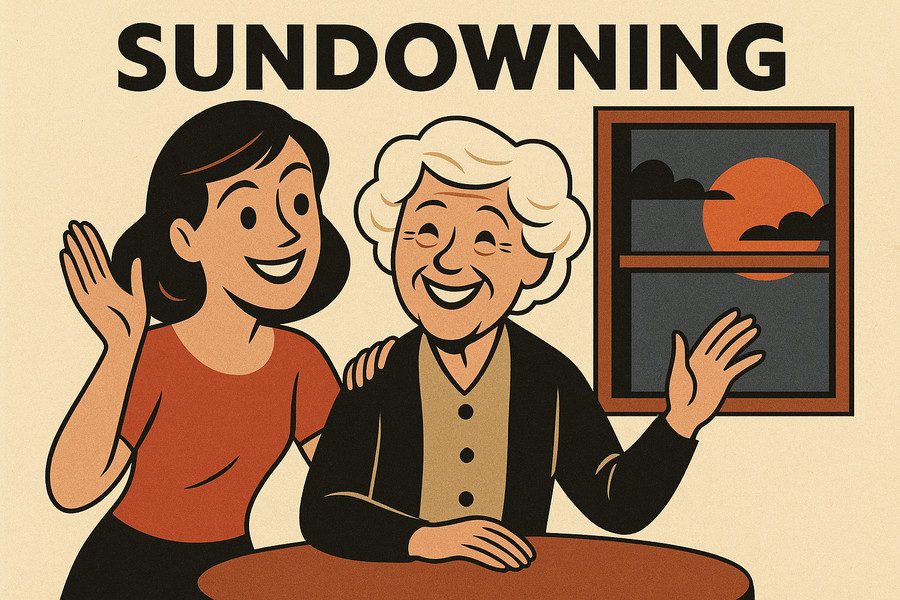
There’s a name for it—sundowning. But I just call it The Beast.
It started around 3:30. The shadows got weird. The clock felt off. She started pacing. Wringing her hands. Asking to go home. Getting angry when I told her this is home.
It was the worst part of the day.
But again—routine doesn’t solve it. It softens it.
What worked (sometimes):
The goal is to ease the descent. To make the transition to evening less sharp.
Sometimes, all she needed was me sitting beside her. Not fixing. Just being.
That’s the hardest part, isn’t it?
Just being.
Let me be clear: this isn’t about perfection.
This isn’t military school.
You’re not failing if the nap happens at 3:17 instead of 2:45. Or if the lasagna was supposed to be tuna casserole and now it’s just… toast.
There’s a huge difference between routine and rigidity.
Routine is flexible. It’s forgiving. It bends with the weather, the mood, the unexpected knock at the door.
Rigidity? That’s a straightjacket. And your person will feel it. So will you.
So here’s what I did:
Because the routine is there to help—not to hurt.
And the second it becomes a burden?
I paused. took a deep breath. And started again the next day.
There was a time I thought bedtime routines were for toddlers and overachieving TikTok wellness influencers with eucalyptus oil and gratitude journals.
Then dementia happened.
And suddenly, bedtime was a battleground.
She didn’t want to sleep. She didn’t know why she had to sleep. Some nights, she didn’t even recognize the bed.
Cue the screaming. The pacing. The weird sobbing that breaks your heart in half.
So I got serious about nighttime rituals. Not fancy. Not complicated. Just consistent.
Here’s what that looked like then:
Some nights it still went sideways. She got up five times. Asked for her mom. Cried about the dog we hadn’t had in 20 years.
But more often than not, the routine worked its quiet magic.
It didn’t cure her. It comforted her.
And that’s enough.
Here’s the dirty secret they don’t tell you in those chirpy caregiver guides:
Sleep deprivation will turn you into a monster.
I once hallucinated an entire conversation with a talking fern because I hadn’t slept more than three hours in two weeks. Not proud of that. Just honest.
And if sleep is hard on you, imagine what it’s like inside your loved one’s brain.
Dementia messes with sleep cycles. Makes dreams scary. Turns the night into this long, looping horror show.
But a routine helps. Again and again, we went back to it.
Sleep isn’t guaranteed. But it’s invited.
And when we both slept—even a little—everything the next day was easier.
I was less angry. She was less afraid.
We met in the morning like strangers who maybe remembered how to love each other.
And that? That’s a miracle.
Because it will.
Flights get delayed. You get the flu. The power goes out. Someone drops by unannounced. And boom—routine gone. Chaos in. Panic at the disco.
I used to spiral. I used to think missing one bedtime or skipping one meal would undo everything.
But guess what?
Routines can be rebuilt.
You just have to do it gently. Slowly. Kindly.
After a bad day (or week), we went back to basics:
I didn’t rush her. I didn’t rush myself. I let us find the rhythm again.
Think of it like muscle memory. Even when it feels lost, the body remembers.
You’re not starting over. You’re just returning.
And that makes all the difference.
This part sucks.
Because just when you’ve got a routine that works—bam. The disease shifts.
She can’t walk to the mailbox anymore. She forgets how to use a fork. She doesn’t want music, just silence.
And you’re like, What now?
The answer?
You change the routine.
Not because you failed. But because you’re paying attention.
You’re following her.
And as heartbreaking as it is, this is where the real love shows up.
Love isn’t holding on to what worked last month.
Love is adapting. Softening. Letting go.
If bath time is too scary now, try a sponge bath. If music is overstimulating, try humming. If she no longer recognizes breakfast foods, offer her a cookie at 8 AM. (No shame.)
The point is comfort. Not correctness.
You are not here to win gold stars.
You’re here to make this disappearing life feel a little less terrifying.
And you’re doing it beautifully.
Yeah, you.
The one who hasn’t peed alone in three days. The one microwaving the same coffee for the fourth time. The one whisper-screaming into a pillow at midnight.
You need a routine.
Not for productivity. Not to “thrive.” Just to survive.
Something that’s yours. Even if it’s 10 minutes.
Here are some that kept me upright:
These are tiny rituals. Not self-care in the Instagram way. More like: I’m still human. I still have a body. I still matter.
And when I kept those little promises to myself?
I showed up better for her.
And that’s everything.
You know what’s wild?
How much peace there is in sameness.
It’s the chipped mug with tea that smells like childhood. The same cardigan. The same corner of the couch. The same humming of that old song she used to dance to barefoot in the kitchen.
For someone with dementia, everything is slipping. Names. Faces. Places. The way home.
But a routine?
A routine is a little lighthouse.
It says, Here. You’re here. You’re safe.
That’s the real magic of consistency—it’s love in disguise. It’s not flashy. It’s not Instagrammable. It’s repetition. It’s boring. And it’s beautiful.
Because when memory goes, muscle memory stays.
And when the world gets too loud, too weird, too scary, your rhythm becomes their refuge.
You don’t need to fix them.
You just need to keep showing up.
We never stopped dancing.
Even when she didn’t know the words. Even when she forgot who I was halfway through the song.
We still danced.
In the same kitchen. With the same creaky floorboards. The same smell of soup and lemon cleaner. The same dog barking outside.
This wasn’t about holding onto what was.
It was about finding safety in what is.
So keep the schedule. Keep the tea. Keep the same three songs on repeat.
And when the hard moments come—and they will—let the routine hold you.
Even if it’s just long enough to catch your breath and cry into a dish towel.
You’re not doing it wrong.
You’re doing something incredibly brave.
Over and over again.